

About Cataract
Cataract is an eye disease that causes objects to appear hazy. The human eye contains a transparent lens, which plays an important role in focusing on what we see. This transparent lens can appear cloudy as you age, become inflamed in the eye, or have trauma. In general, 70% of the population will experience cataract symptoms by age 60 or older, and 90% by age 70 or older.
Cataract surgery is the most common single surgery performed in developed countries. In 1990, approximately 37 million people worldwide became blind. Of those, 40% were caused by cataracts. Every year 1-2 million people become blind. Worldwide, one person is blinded every 5 seconds and a child is blinded every minute. In 75% of these cases, blindness is treatable or preventable. However, 90% of blind people live in some of the poorest parts of the developing world, and without adequate intervention, the number of blind people will increase to 100 million by 2025.
Most cataracts are caused by aging of the lens. The lens is unusual in that it is one of the few body structures that continues to grow throughout life, as new lens fibers, the crystallin protein, continue to build up in the lens and the old one is not replaced. The transparency of a lens is maintained by many interdependent factors responsible for optical homogeneity, including crystallin molecular structure and chemical composition. As we age, a tan pigment gradually builds up inside the lens, reducing light transmission. There are also structural changes in the lens fibers, disrupting the fiber arrangement and regular architecture needed to maintain optical clarity.
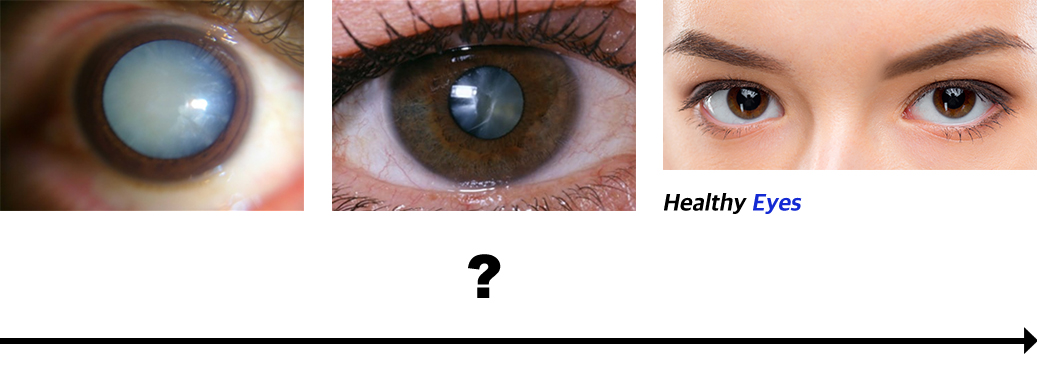
Cataract Therapy
Cataract treatment is usually conducted surgically. When patients are in the early stages of cataracts, they receive drug treatment, but drug treatment only delays the progression of the initial cataract and cannot restore the already degenerated lens to a transparent state, so most patients undergo surgery.
For cataract therapy, drugs that prevent protein degeneration in the lens that cause cataracts are used. Treatments include 1. drugs that block the binding of harmful substances to the lens, and 2. drugs that prevent clouding of the lens by activating proteolytic enzymes or improving blood flow.
‘Pyrenoxine’ and ‘iodine’ are mainly used for the initial symptoms of senile cataract, and ‘bendazak lysine’ is mainly used for degenerative cataracts, pediatric and diabetic cataracts.
Pirenoxine prevents degeneration of the lens by competitively binding to the lens protein, preventing the binding of harmful substances that denature the lens protein.
Iodine improves blood flow and promotes metabolism. When applied to the eye, it prevents the progression of cataracts and promotes vision recovery by removing opacity of the lens and improving retinal circulation disorders.
Bendazac lysine inhibits the progression of cataracts by inhibiting the aggregation and precipitation of lens proteins. It reduces lens opacity by restoring the action of proteolytic enzymes in the lens. For bendazac lysine, it is recommended to treat 500 mg three times a day for adults and 250 mg three times a day for children. However, if you become infected with measles or chickenpox while taking it, it can be fatal. If you suspect an infection, you should seek medical attention immediately. Also, bendazac lysine may affect liver function and should not be administered with drugs that stimulate bile secretion.
Julia Laboratory discovered 20 candidates that may dissolve the crystallin aggregates, the cause of cataracts.
COPYRIGHT ⓒ JULIA LABORATORY. ALL RIGHTS RESERVED. DESIGNED BY MARVEL WORKS
 ENG
ENG  KOR
KOR